
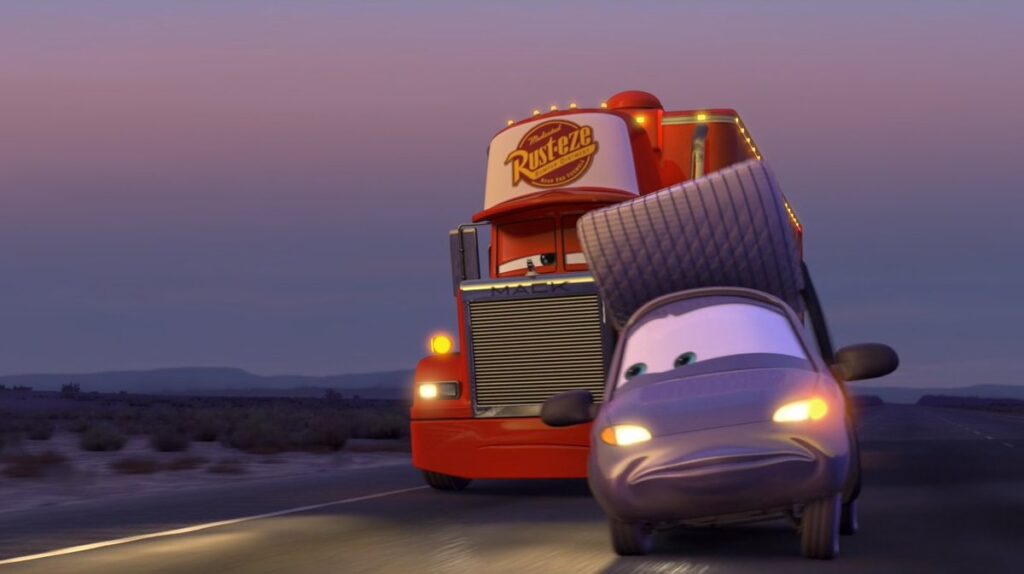
This past weekend, for my son’s third birthday, we got to show him his first movie: Cars. It was never my favorite Pixar movie growing up—in fact, I considered it the only lame Pixar movie for a while (ah, to go back to the days when Cars was the “lame” Pixar movie)—but watching it with my son was a great deal of fun. In fact, I hadn’t given the movie enough credit as a kid—it’s a solid story about learning humility, empathy, and compassion. As a sports movie, it has a couple of enjoyable races bookending the movie, the first one revealing Lightning McQueen’s arrogance in how he attempts to win the race alone and the finale demonstrating how he has learned humility in accepting help from his new friends from Radiator Springs. But the final race doesn’t stop there: it doesn’t just show him winning the race by using all the cool racing techniques he learned from his new friends or relying on their help; instead, in something of a twist for a typical sports movie, he loses. And he does so by choice to show compassion for the veteran racecar The King, a deed that places him last. It’s a profound and inspiring moment, and one that elevates it above the “lame” label I gave it as a youth.
Nevertheless, after a witching hour diaper change with my daughter, I realized in my half-awake stupor one key element that was lacking from Cars that kept it from attaining the excellence of other Pixar movies like Toy Story, Finding Nemo, or Monsters, Inc.: fusion of world and story. You could easily retell the story of Cars without the characters being sentient cars: all of the characters could be replaced by humans, and the story would barely have to change. The aesthetic would shift and certain scenes would need to be blocked slightly differently, but the core story could still be told: it’s about an arrogant racer who, as a result of his arrogance, ends up in a small town where he learns humility, overcomes his prejudice, makes friends, and helps out the town before returning to his celebrity life for the big race. Nothing in that requires any character to be a sentient car.
Compare that with Toy Story. While it explores very human issues of jealousy, rivalry, and friendship, the story revolves around the fact that the main characters are toys. Being a toy means that they have a very unique sense of purpose, bringing joy to the kid who owns them, and that purpose is one that Buzz has to realize rather painfully through the course of the story. As Woody points out to him, “You! Are! A! Toy!” (a scene that was reanimated with the characters as cars for the outtakes of Cars, underscoring my point that the cars are mostly aesthetic). And the way that Buzz learns that point is attempting to fly out a window by jumping from a banister and then losing an arm, which gets reattached later by the mutant toys of Sid’s room. The specific things that happen in that learning process as well as in many other scenes are only possible because the characters are toys. Retelling the story with only humans would require a great deal of additional change for it to still make sense. It is actually a story about toys.
The same goes for another Pixar classic, Finding Nemo. In a sense, you could tell that story with all human characters as well—a weak boy gets separated from his anxious father, who has to go on an adventure to rescue his son, and they learn courage, trust, and independence along the way—but the fact that the characters are fish matters. Typically, if a human child gets abducted, there is a much more evil motive behind the act than a diver collecting a fish for a tank at a dentist’s office. That’s a uniquely fishy problem. And most of the literal obstacles Marlin faces on his journey are ones unique to a fish: sharks, deep trenches, jellyfish, a whale’s belly, etc. Perhaps a human could replace Marlin and face all of these problems, but they would be framed very differently. Marlin and Dory’s encounter with the sharks has the conflict that it does because they are small fish with sharks who are in an AA-like program trying to quit eating fish (“Fish are friends, not food!”)—the conflict of the scene is built on the fact that the characters are not humans. I mean, what would the analog be if the characters were all humans? Are the sharks now people recovering from serial cannibalism? Somehow, it’s not the same.
At the risk of overstating the point, I’ll consider the example of Monsters, Inc. as well. Again, the themes explored by the story are relatable and human, but the events of the story are ones that are only possible within the premise of the setting: What if monsters are real and scare little children because screams generate power, but it’s dangerous for the monsters because they believe children are toxic? The problems of “a lost child is separated from their home and needs to be returned” and “the characters work for a corrupt company that they need to expose” are ones that could be told in an ordinary human situation (though I wonder what other stories have combined those disparate plotlines), but Monsters, Inc. tells them in a way that is unique to the situation of their world. The fact that they are monsters affects what happens in the story and why.
All these examples are meant to contrast with Cars, in which the fact that the characters are cars has little to no bearing on the plot. The conflicts and obstacles that drive the story are not especially unique to cars; rather, the world of Cars feels incredibly bizarre because it is so at odds with the sentience or animation of the vehicles. I find myself asking too many questions like: Why do cars need a wheatfield? How did the cars refurbish the Cozy Cone? What does it mean that Luigi references the designer of Ferrari at the end? Do they know car designers and manufacturers? While the worldbuilding in the other Pixar movies I mentioned is by no means complete or thorough, that of Cars has much more noticeable and perplexing gaps. I think an easy way to explain it is that the other movies are still set in or adjacent to the familiar human world; we just get a peek into the secret world of toys, fish, or monsters. In the world of Cars, cars are just the people (and animals and insects apparently) of that world; they’re little more than humans in car costumes.
So what? My goal is not to bash or nitpick a perfectly decent children’s movie but to make a point about the significance of melding setting and world building with story. The premise of Cars is not a narrative premise, only a setting and not a very fleshed out one at that. It’s more of a window dressing for a story rather than a distinct world in its own right, and that’s fine. The setting can be there to simply make the story more appealing or suitable for the audience—Cars would not work quite as well with children if they weren’t sentient cars. You can do Hamlet with lions (Lion King) or The Tempest in space (Forbidden Planet) or Romeo and Juliet in modern times (West Side Story)—go for it! But be aware of the degree of significance that the setting has on your story. Is it just costuming and scenery or is it something more? I think when the setting is melded with the story, then both are more compelling. Each of the examples above, Lion King, Forbidden Planet,and West Side Story, adapt their source material to their worlds, resulting in interesting retellings. West Side Story is especially illustrative of this. While it is not my favorite musical, it does tell the story in New York with gangs in a way that would only make sense with their chosen context. In contrast, Baz Lurmann’s Romeo + Juliet, which I will admit I have not yet had the stomach to finish, slaps Shakespeare’s story and text into a modern context and costume that is mostly comical, doing little to meaningfully showcase the world or the story, the guns labeled as swords being a prime example of the dissonance (there is much else wrong with the movie, even in just the first forty-five minutes I saw five times in a day as a substitute teacher, but that is beside the point). The world in which a story is set can be merely decorative, but the more a story is shaped by its world, the more immersive, memorable, and meaningful it will be.
This is an issue I’ve thought of much while writing The Dragon’s Widow, a hard-boiled detective story set on a planet inhabited primarily by dragons. I was confident that the narrative could only happen in the world I was creating, but I was concerned to make sure the dragons felt like dragons and not just humans in dragon costumes. They needed to think like dragons, talk like dragons, and act like dragons so that they would take up a distinctly dragonish presence on the page. Of course, that doesn’t mean they would be completely inhuman since that would make the story I wanted to tell difficult if not impossible—and besides, there is something of the dragon in humanity. In any case, I didn’t want The Dragon’s Widow to simply be a Chandler novel with a new paint job but something somewhat unique and fresh, and I think that inhabiting the world and its specific eccentricities is one of the ways to accomplish that as a writer. Don’t just put on the world like a cheap costume; embody it and the humanity will find its way through.
Very smart. Very well written. Excellent read!
It goes to your point that there is another movie (“Seven Days in Utopia”) that is essentially the same plot as “Cars”, but with racing swapped out for golf.
Certainly something to grapple with when creating stories.